Our Story
From the House of Wisdom to the Age of AI
From Bayt al-Hikma to the Age of AI:
The Story of HikmaTech
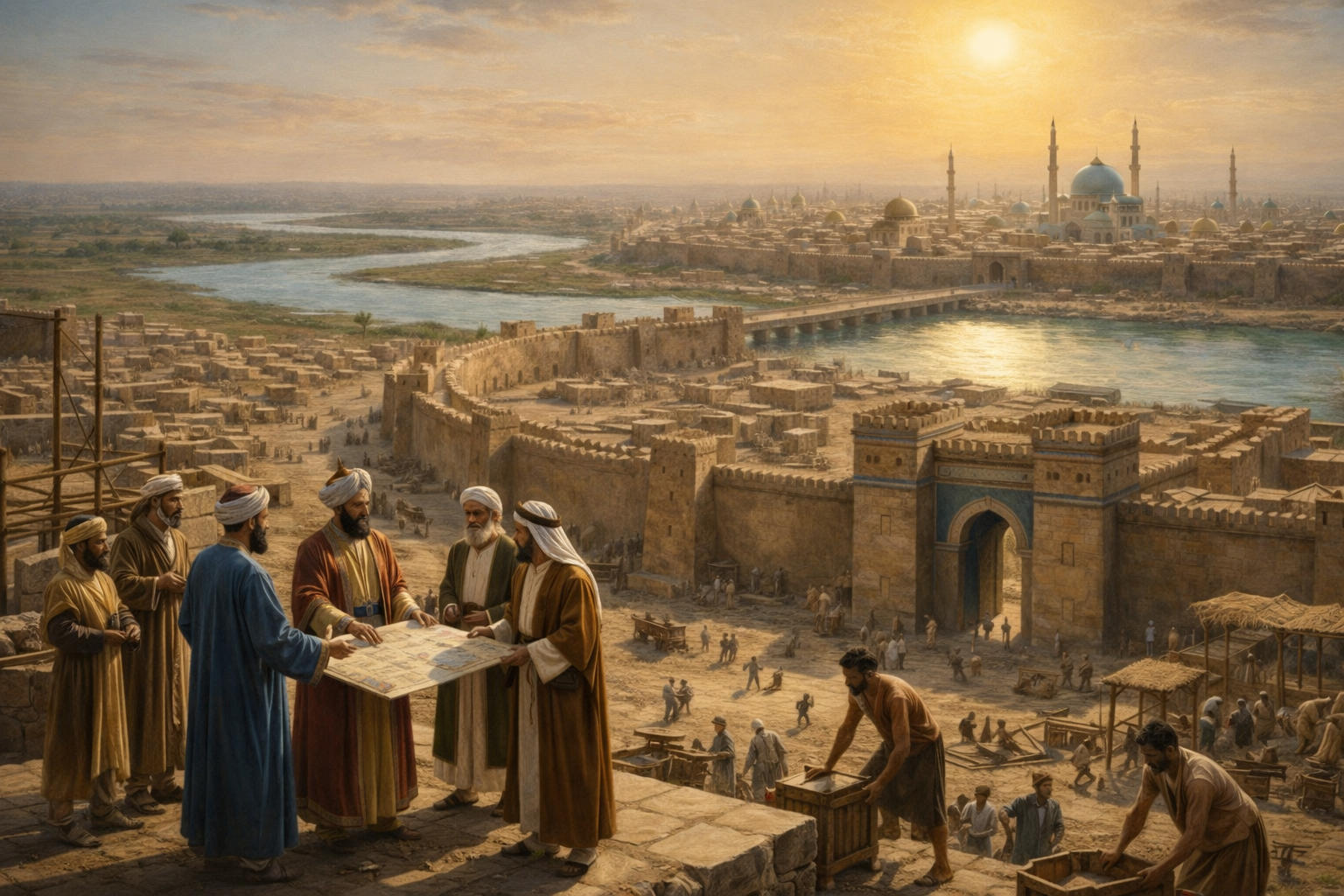
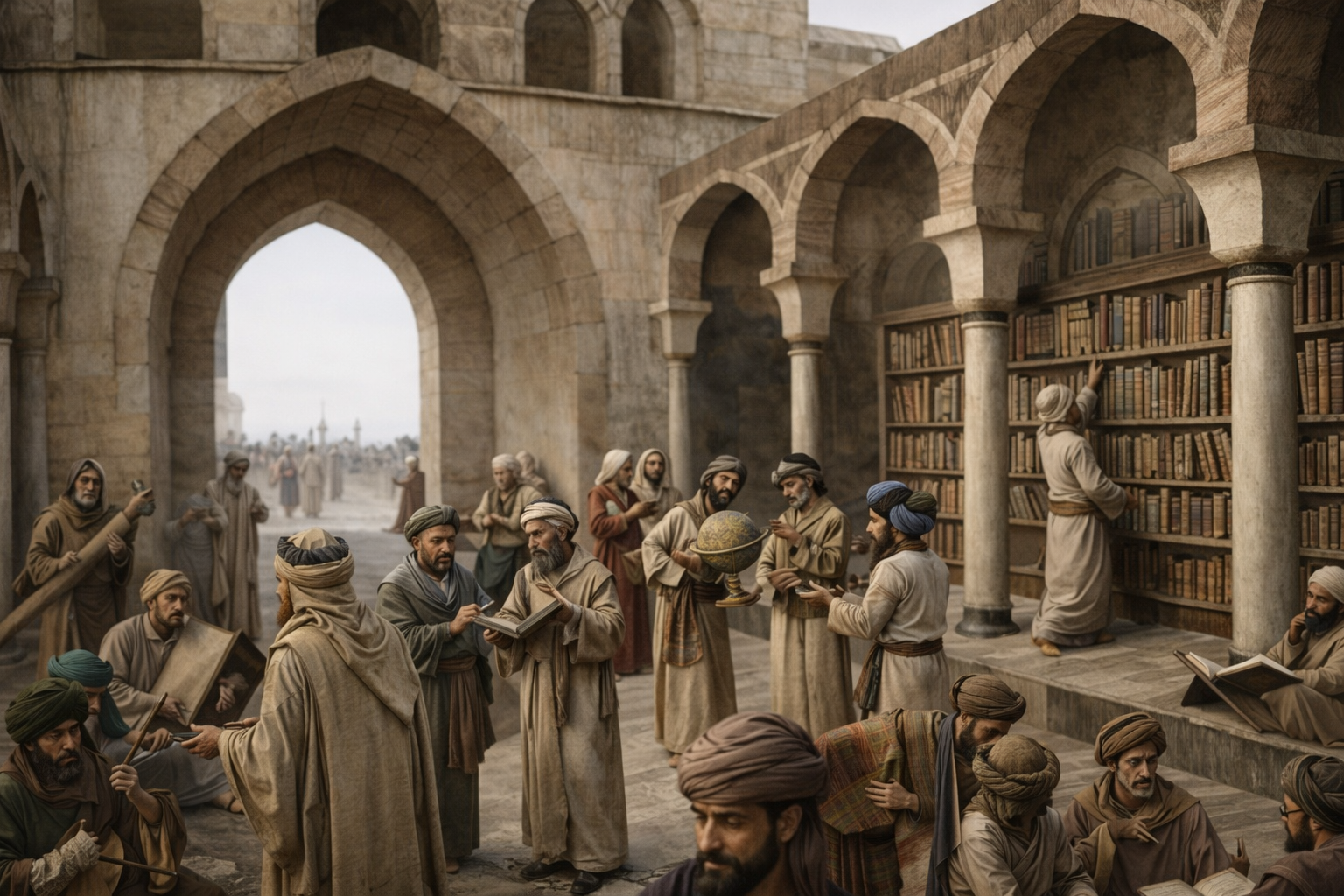
In ninth-century Baghdad, under the Abbasid Caliphate, education was not organised around classrooms, semesters, or standardised curricula. At Bayt al-Hikma, learning unfolded through people rather than programmes. Scholars mentored students directly; knowledge advanced through translation, debate, commentary, and contribution. Progress was individual, paced by intellectual readiness, and recognition came through trust and demonstrated mastery rather than formal certification.
This was the classical Sheikh–Ṭālib model: adaptive, apprenticeship-based, and deeply personalised. It produced intellectual depth and originality—but it could not, by design, educate an entire civilisation.
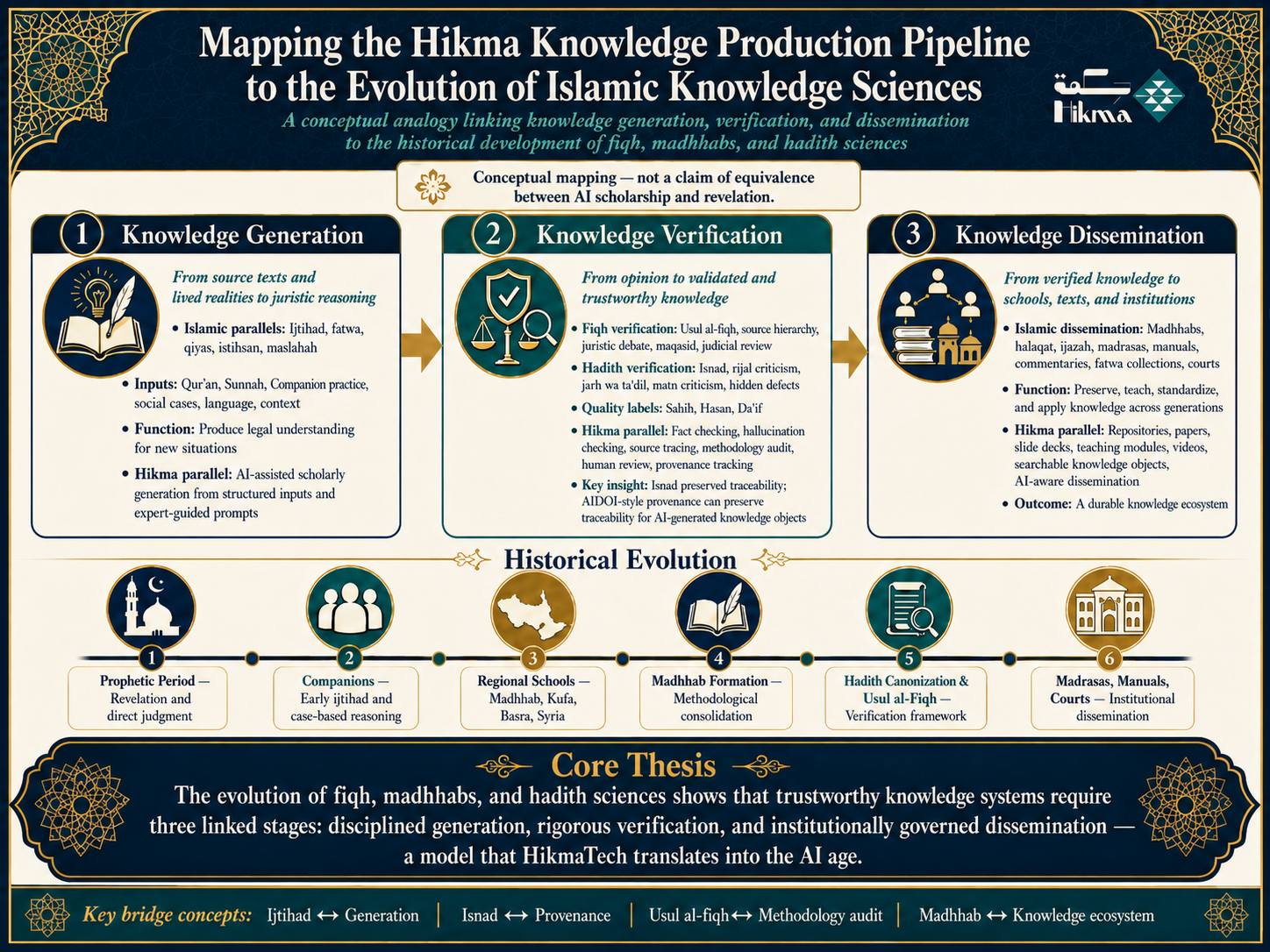
Yet beneath this scholarly ecosystem lay something deeper: a structured process of knowledge production. Islamic scholarship evolved through three interconnected stages:
- Knowledge Generation through ijtihad, legal reasoning, analogy (qiyās), and contextual interpretation;
- Knowledge Verification through usul al-fiqh, juristic review, isnād criticism, jarḥ wa taʿdīl, and methodological scrutiny;
- and Knowledge Dissemination through madhhabs, ijazah, madrasas, manuals, commentaries, courts, and institutional teaching.
These stages transformed revelation and lived realities into durable civilisational knowledge. They form the conceptual foundation of what HikmaTech later reinterprets for the age of AI.
From Mentorship to Mass Education: The Seljuk Transformation
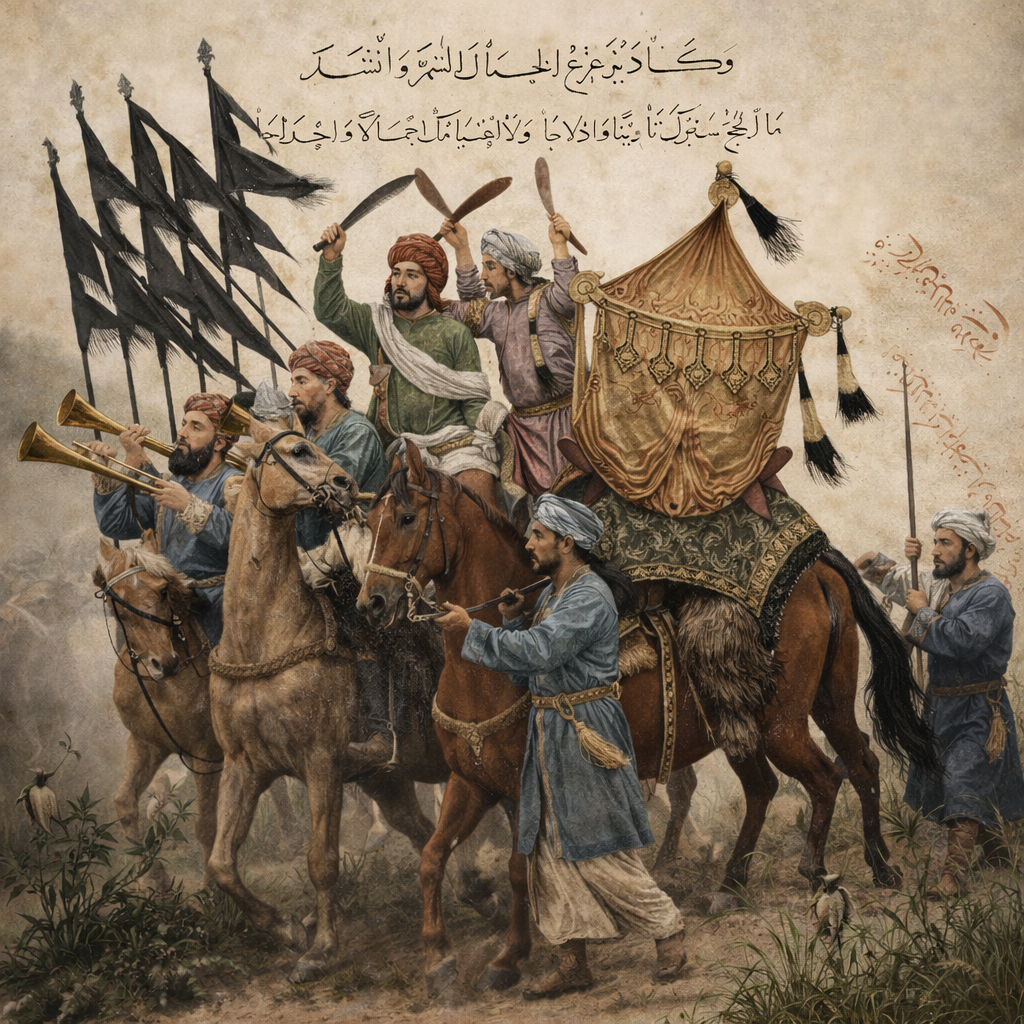
As the Islamic world expanded geographically and administratively, the limits of elite mentorship became a structural challenge. The question shifted from cultivating brilliance to ensuring coherence, continuity, and access across a vast polity.
In the eleventh century, under the Seljuks, Nizam al-Mulk responded by founding the Nizamiyya Madrasas. Education was institutionalised: curricula were fixed, texts standardised, teachers salaried, and students organised into cohorts. Learning became synchronised in time and content, enabling replication at scale across the caliphate.
This transformation was not simply educational—it represented the institutionalisation of knowledge dissemination after centuries of knowledge generation and verification. Earlier scholarship had already produced juristic methods, regional schools, hadith authentication systems, and methodological frameworks. The madrasa became the mechanism that preserved and propagated them.
This transformation was also strategic. The Nizamiyya system emerged in direct competition with the Fatimid educational network centred on Al-Azhar Mosque, which had already demonstrated how mass education could shape doctrine, authority, and influence across the Islamic world.
What Was Gained—and What Was Lost
The madrasa model achieved what Bayt al-Hikma could not: education for the masses, doctrinal stability, and institutional continuity. Knowledge could now travel faster than scholars themselves.
But scale came with trade-offs. Adaptive mentorship gave way to fixed syllabi. Mastery yielded to time-bound progression. Competence was increasingly inferred from completion rather than lived practice. The Sheikh–Ṭālib relationship survived, but it was no longer the organising principle of education—it became an exception within an institutional framework.
The earlier Islamic knowledge ecosystem had balanced generation, verification, and dissemination as linked stages. Over time, dissemination increasingly dominated. Institutions became efficient at transmitting established knowledge, but less effective at reproducing the personalised cycles of inquiry, critique, and scholarly apprenticeship that originally generated it.
From the Renaissance to the Industrial University
Over time, this institutional logic moved beyond the Islamic world. During the European Renaissance and the later Industrial Age, it evolved into the modern university system. Standardisation intensified: degrees, grades, examinations, and credential hierarchies became the dominant measures of learning.
While this model proved effective at producing uniform outcomes and administrating large populations, it gradually detached education from apprenticeship, tacit knowledge, and real-world skill formation. By the twentieth century, higher education had become largely classroom-centric and credential-driven, with genuine mentorship confined to narrow spaces such as doctoral supervision or artisanal trades.
The AI Inflection Point
HikmaTech - The AI-Run University
Artificial intelligence introduces a rupture in this historical trajectory. For the first time, the constraint that forced education to abandon mentorship—human scarcity—no longer applies.
AI systems can tutor, critique, model expert reasoning, and adapt instruction continuously, without exhaustion and at negligible marginal cost. What once required proximity to a master scholar can now be delivered globally, persistently, and at scale. This is not merely automation of content; it is the automation of cognitive apprenticeship.
At Hamad Bin Khalifa University in Qatar, a group of researchers and technologists have been asking a provocative question: What would a university look like if it were designed today, in the age of AI, rather than inherited from the industrial era? Their answer has taken shape as HIKMA Institute of Technology or simply HikmaTech, an ambitious attempt to rethink academia itself.
The answer emerged by revisiting the older Islamic knowledge model itself: knowledge must first be generated, then verified, and only then disseminated. AI makes it possible to rebuild this sequence at scale.
HikmaTech: Re-Architecting the University
This inflection point is the foundation of HIKMA Institute of Technology or HikmaTech. HIKMA—Human-Inspired Knowledge by Machine Agents—is neither a return to pre-modern informality nor a continuation of the industrial university. It is a deliberate re-architecture of education that restores the logic of classical mentorship while preserving the reach of mass education.
Central to this architecture is the HIKMA Knowledge Production Pipeline, inspired conceptually by the historical evolution of Islamic scholarship:
Knowledge
Generation
Ijtihad · Qiyās · Istihsān
AI systems assist in producing new knowledge objects from structured inputs, literature, data, lived realities, and expert guidance—mirroring classical juristic reasoning.
Knowledge
Verification
Usūl al-Fiqh · Jarḥ wa Taʿdīl
Multi-layer verification: fact checking, hallucination auditing, provenance tracking, novelty assessment, and human scholarly review—echoing isnād criticism.
Knowledge
Dissemination
Madhhabs · Ijāzah · Madrasas
Verified knowledge is transformed into courses, papers, slide decks, videos, repositories, AI tutors, and persistent knowledge ecosystems for global reach.
Central to this architecture is also the HIKMA 80–20 Model. Approximately 80% of academic and educational labour is executed by AI, while 20% remains explicitly human.
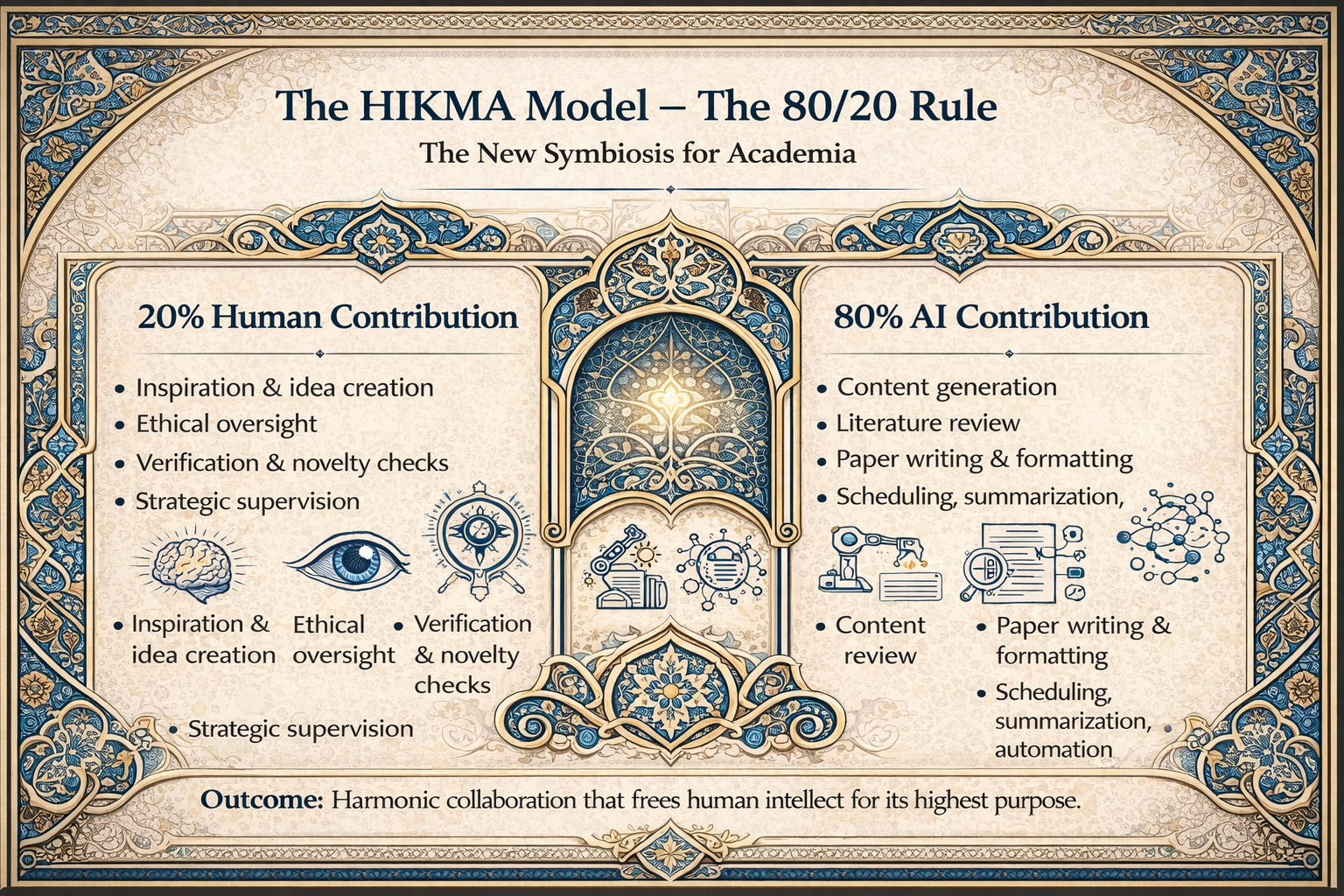
AI undertakes content generation, literature synthesis, tutoring, assessment, feedback, scheduling, and continuous adaptation. Human scholars focus on purpose, intellectual direction, ethical judgment, validation of novelty, and the conferral of scholarly authority. Rather than diminishing scholars, the model concentrates human effort where it matters most.
The New Sheikh–Ṭālib Model at Scale
Within HikmaTech, mentorship is no longer scarce. AI agents function as persistent intellectual companions—guiding inquiry, challenging assumptions, demonstrating expert reasoning, and providing immediate, personalised feedback. Human scholars act as senior mentors who shape trajectories, supervise depth, and grant legitimacy.
Learning is no longer paced by semesters or seat time, but by demonstrated competence. Education is reorganised around skills rather than subjects. Learners progress through nano-courses that target specific, applied capabilities, developed through doing—research, writing, analysis, and problem-solving—rather than passive consumption.
Certification mirrors the classical logic of ijāzah: customised, skill-based recognition granted upon verified mastery, supported by AI-assisted evaluation and human endorsement. What was once personal and exclusive becomes personalised and scalable.
Reinventing Conferences, Publications, and Teaching
The implications extend well beyond the classroom. Traditional academic conferences often take months to organise, cost millions, and require large teams. HikmaTech's AI-driven conferencing model compresses this cycle to days rather than months, with a fraction of the cost and staffing.
In some cases, AI agents generate papers, conduct peer review, assemble programmes, schedule sessions, and produce summaries end-to-end. Yet the process still mirrors the classical sequence:
Generation → Verification → Dissemination
Papers are created, validated, provenance-checked, and then transformed into conferences, repositories, teaching assets, and scholarly outputs.
In publishing, AI Scholar Frontier and HikmaXiv support literature discovery, drafting, formatting, verification, provenance tracking, and dissemination, lowering barriers while preserving oversight.

Teaching is likewise transformed. Instead of static lecture notes revised every few years, AI systems generate continuously refreshed course content with narrated slides, interactive materials, and adaptive learning paths. Professors define intent, structure, and standards; AI handles delivery, iteration, and personalisation.
Echoes of an Older Vision
The choice of the name HikmaTech is deliberate. The House of Wisdom in Baghdad was not merely a library; it was an ecosystem. Translators worked alongside mathematicians; philosophers debated physicians; knowledge flowed across cultures and disciplines.
HIKMA Institute of Technology positions itself as a digital successor to that vision. Where Bayt al-Hikma gathered human minds under one roof, HIKMA gathers human judgment and machine intelligence within a single orchestrated knowledge system.
There is also an ethical dimension: leaving AI to evolve without scholarly frameworks risks fragmenting knowledge. HIKMA seeks to embed AI within a human-centred academic tradition.
The historical legacy of Islamic scholarship demonstrated that trustworthy knowledge required disciplined creation, rigorous verification, and structured dissemination. HIKMA attempts to translate that civilisational logic into AI-era systems.
Individuals as Their Own Institutions
Previous eras relied on scholars, madrasas, libraries, courts, endowments, and later universities as the primary units of knowledge production and dissemination.
HIKMA proposes a different possibility: the individual becomes the institution.
Through AI agents and orchestrated knowledge systems, a single learner, researcher, teacher, or innovator can perform functions that once required entire departments, publishing offices, conference committees, editorial boards, and instructional teams.
A scholar equipped with AI can generate knowledge, verify outputs, teach, publish, mentor, organise events, maintain repositories, and disseminate learning globally.
This creates what HIKMA describes as an Autonomous Knowledge Institution (AKI): an individual empowered by AI to operate as a complete scholarly ecosystem.
In this model:
- AI performs the scalable labour of generation and dissemination.
- Verification remains human-guided and provenance-aware.
- Scholars evolve from content producers into intellectual architects.
- Institutions shift from physical infrastructure to orchestrated human–AI capability.
The university is no longer necessarily a campus. It may become a network of individuals functioning as knowledge institutions, connected through shared verification, provenance, and trust systems.
A Glimpse of the University of the Future?
Critics rightly note that questions remain. Who controls AI-generated knowledge? How is authorship defined? What happens to academic careers built on traditional metrics? The HikmaTech team acknowledges these concerns and frames the institute as an experiment rather than a finished model.
Yet even sceptics agree that higher education is approaching a crossroads. AI systems already write essays, review papers, and tutor students. Ignoring this reality may no longer be an option.
More than a thousand years ago, scholars in Baghdad embraced the translation technologies of their time to expand human understanding. Today, HikmaTech's architects argue, artificial intelligence represents a comparable inflection point.
The future of knowledge will not be human alone, and it will not be machine alone. It will be generated carefully, verified rigorously, disseminated intelligently—and built through human–AI collaboration by design.
Whether HikmaTech becomes a blueprint for the universities of the future remains to be seen. But its story—from the House of Wisdom to the age of AI—returns us to a timeless question:
How should humanity generate knowledge, verify truth, and pass wisdom forward?
Explore the HikmaTech Ecosystem
Discover how HikmaTech is transforming academia across conferencing, education, research, and innovation.